
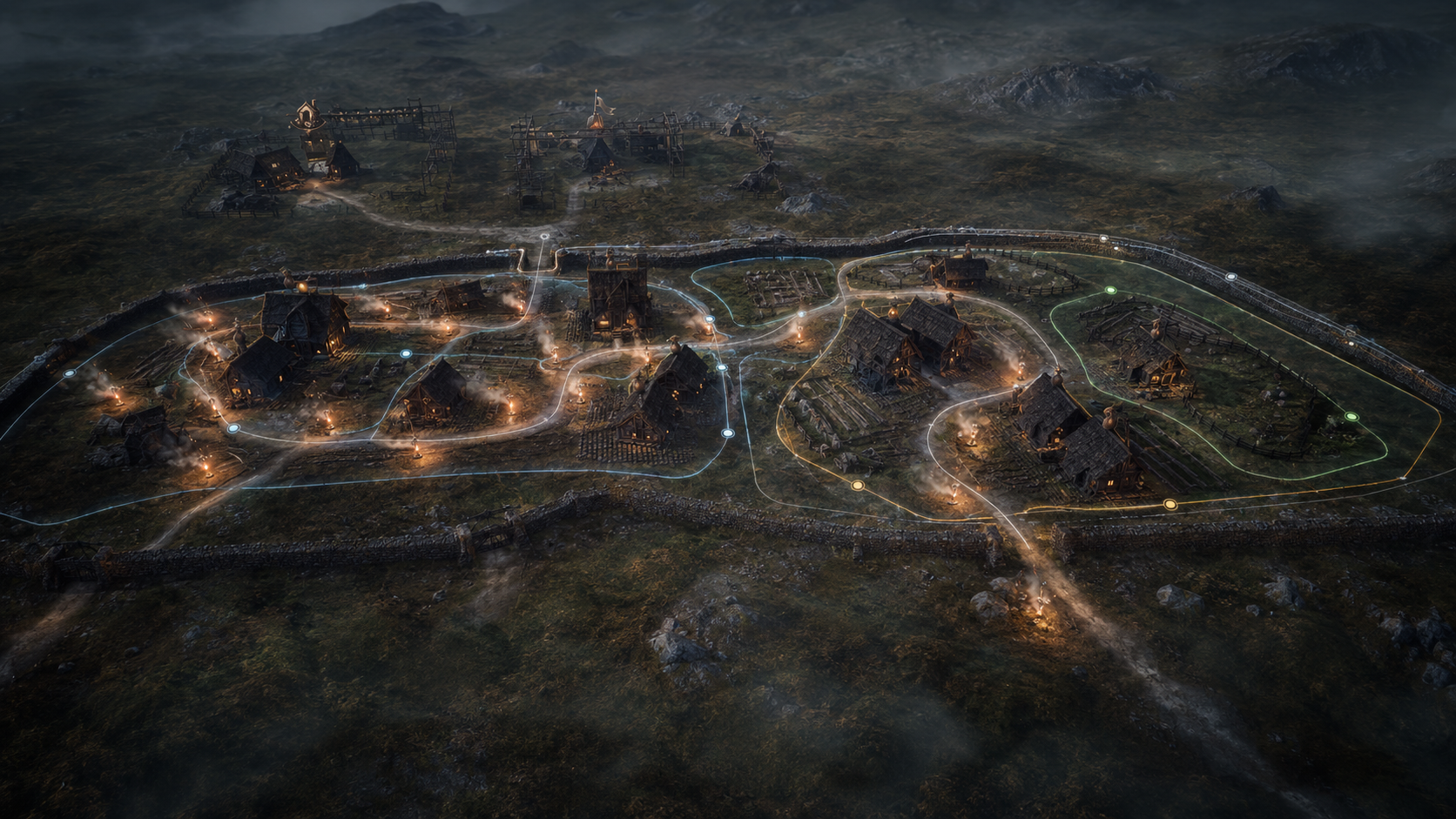
Stormbane’s world is not just a backdrop. It is something we want players to read, question, and understand as they move through it.
One of the systems we have been working on recently is our route and settlement planner. At a glance, this means roads, paths, crossings, buildings, districts, and settlement layouts. But the real goal is bigger than that.
We want places in Stormbane to feel like they exist for a reason.
A road should not feel like it was simply painted onto the terrain. A settlement should not feel like a handful of buildings were scattered into an empty space. A bridge, a gate, a market, a watchtower, a ruined path, or a riverside crossing should all feel like they belong to the same world.
Roads that follow the world
Roads in Stormbane are being built to respond to the land around them.
Rather than treating routes as straight lines on a map, the system considers terrain, water, settlements, and points of interest. A road might bend around difficult ground, approach a river at a more sensible crossing, or connect locations in a way that suggests people have actually travelled there before.
That is important because roads are one of the simplest ways a world can explain itself.
A road tells you where people needed to go. A broken road tells you they stopped going there. A guarded road suggests control. A forgotten path suggests danger, abandonment, or discovery.
Before a quest marker appears, the shape of the world can already start telling a story.
Rivers and roads need to agree
Rivers are not just decoration either.
When a road meets a river, the world has to solve that relationship. Does the route follow the riverbank for a while? Does it cross at a shallow point? Is there a bridge? Would that bridge make the surrounding land more valuable, more dangerous, or more contested?
These are the kinds of questions that help turn a map into a place.
A river crossing might become important enough to attract a small camp, a shrine, a watchtower, an inn, or eventually a settlement. A collapsed bridge might hint at an older route that once mattered. A road that avoids a river entirely might suggest the water is dangerous, difficult, or controlled by someone else.
The aim is for crossings to feel discovered, not stamped down.
Settlements built around intent
The settlement planner follows the same idea.
We are not trying to create random towns. We are trying to create believable places that feel authored, even when the tools are helping with the heavy lifting.
A settlement can be organised around purpose: where roads enter, where people live, where work happens, where important structures belong, and how the whole place connects to the wider region.
That means buildings are not just dropped into empty space. They can be placed in relation to paths, terrain, entrances, neighbouring structures, and key landmarks.
A village path might curve naturally between homes and fields. A market town might form where several roads meet. A defensive settlement might shape itself around gates, walls, watch points, and controlled approaches.
The result should be a place that feels walkable, readable, and useful.
Why rejection matters
One of the less glamorous parts of this work is teaching the planner when to say no.
A building might technically fit somewhere, but that does not mean it belongs there. It might block a route, sit badly on a slope, overlap an important area, or break the intended flow of the settlement.
So the planner does not just ask, “Can this fit?”
It also asks, “Does this make sense?”
That distinction matters. A believable settlement is often defined as much by what is rejected as by what is placed.
Roads as gameplay clues
Routes are also useful because players understand them instinctively.
A maintained road feels safer. A broken road feels tempting. A narrow path into the hills feels risky. No road at all feels like a decision.
That gives the world a quieter way to guide exploration. Instead of relying only on markers, Stormbane can use roads, paths, bridges, clearings, gates, ruins, and settlement layouts to gently pull players toward interesting places.
The geography itself can suggest what matters.
A lonely road to a hilltop ruin feels different from a busy road between settlements. A village beside a river crossing feels different from one hidden deep in woodland. A settlement at the meeting point of several routes naturally feels like a place of trade, travel, or conflict.
A world with connective tissue
The most exciting part is not roads by themselves, or settlements by themselves.
It is how they work together.
A town exists because routes reach it. A bridge matters because people need it. A path exists because something is worth walking to. A settlement near a river crossing might become strategically important. A place at the end of a broken road might feel isolated, abandoned, or forgotten.
This is the connective tissue that helps the world feel coherent.
We want players to be able to look at a place and understand something about it before anyone explains it. Why is the gate here? Why does this road curve that way? Why is there a tower near this crossing? Why does this old path lead into the hills?
Those questions are part of exploration.
What comes next
The route and settlement planner is still in active development, but it is already helping shape how we think about Stormbane’s world.
The goal is not to make everything perfectly neat. Real places are often messy, changed by time, conflict, weather, trade, and survival. What matters is that the mess has logic behind it.
A bridge, a road, and a village should feel like they belong to the same story.
And ideally, players should be able to read that story just by walking through the world.